

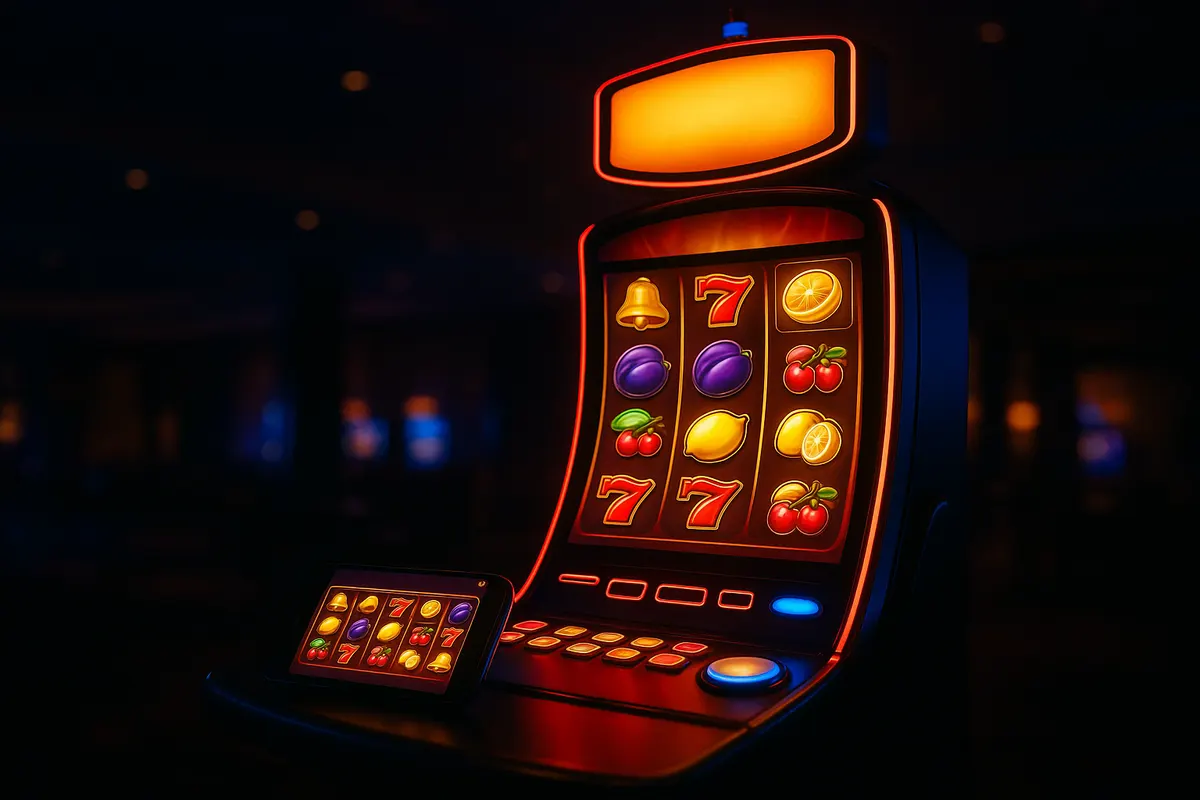
What is a casino gaming cabinet?
A slot with 96% RTP returns roughly 96% of all money wagered over the long run, and that figure doesn’t care whether the game is running on a steel cabinet on a Buenos Aires casino floor or on a phone in your kitchen. The hardware changes almost everything about how a session feels. It changes almost nothing about the underlying math.
A casino gaming cabinet is the physical machine that houses a slot game: the chassis, the screens, the button deck, the money-handling hardware and the computer board that runs the game and its random number generator. In the industry, “cabinet” refers to the hardware platform, while the games installed on it are separate products. One cabinet model can host dozens of different titles, and the same title can often be ported across several cabinets.
Strip a modern machine down and you get roughly these parts:
- Displays — usually one large main screen plus a secondary or top screen, often with a lit topper for visibility across the floor.
- Player controls — a button deck and/or touchscreen for bet size, lines and spin.
- Money handling — a bill validator and a ticket printer. Coin mechanisms have largely disappeared from modern floors in favour of ticket-in, ticket-out (TITO) vouchers and cashless systems.
- Game controller — the processing board that runs the game software and the RNG, plus secure storage for the certified game files.
- Peripherals — speakers, sometimes a haptic seat or bass transducer, a loyalty card reader and a connection to the casino’s monitoring system.
Every one of those components sits inside a regulated frame. Games and RNGs are tested by independent labs, the cabinet itself has to be approved by the local gaming authority, and the machine reports its meters to the operator’s system and, in many jurisdictions, to the regulator. Zitro’s Fantasy cabinet, recently installed at Casino Buenos Aires, is a good, current example of what that package looks like in 2020s form.
Zitro’s Fantasy cabinet: a modern example
Zitro, a supplier of both gaming machines and iGaming titles, announced the installation of its Fantasy cabinet at Casino Buenos Aires. The machine arrived with the exclusive titles Brave Dragon and Lion Falls, alongside Legendary Hammer, a game the company launched in the region more recently.
Zitro describes Fantasy in terms of its design and its presence on the gaming floor: a distinct visual identity for each title, high quality graphics and differentiated game mechanics across the games installed on it. The supplier says Brave Dragon, Lion Falls and Legendary Hammer arrive with proven performance in multiple markets, and that since launch Fantasy has become one of the stronger performers in its portfolio, with a widening footprint among major Latin American operators.
From the operator’s side, Casino Buenos Aires general manager Darío Montero framed the addition as a premium product his customers had been asking for, adding that the venue is always looking to bring value and entertainment to its offering. Alejandra Burato, Zitro’s regional director for Latin America, spoke for the supplier on the installation.
Read past the marketing language and the interesting part is the strategy. Fantasy is a content vehicle. The reason a casino leases or buys a specific cabinet is the game library attached to it, and titles like Brave Dragon and Lion Falls are exclusive to that hardware. That exclusivity is the single biggest practical difference between cabinet gaming and online play: you cannot download Brave Dragon, and no online casino can licence it into a browser lobby. If you want to play it, you go to a floor that has the machine.
Gaming cabinet vs online slots: where they actually differ
Both formats are RNG-driven slot games with a built-in house edge. Beyond that, the two experiences diverge in hardware, pacing, money flow and cost structure. Here’s the side-by-side, with the honest caveat that specifics vary by operator and jurisdiction.
| Element | Casino gaming cabinet | Online slot |
|---|---|---|
| Where the game runs | Certified board inside the machine, on a licensed floor | Provider’s remote server, streamed to browser or app |
| Input | Physical button deck, touchscreen, lit topper, seat audio | Mouse, tap or swipe on a shared screen |
| Money in | Cash via bill validator, TITO ticket or cashless wallet | Card, bank transfer, e-wallet, instant payment rails |
| Money out | Printed ticket, cage payout; large wins hand-paid | Withdrawal request, subject to KYC and processing time |
| Game library | Limited to what’s on the floor; some titles cabinet-exclusive | Often hundreds or thousands of titles in one lobby |
| Minimum stake | Typically higher; set by the operator per machine | Typically lower, often fractions of a unit per spin |
| Pace | Manual spins, slower rounds per hour | Turbo and autoplay available, far more spins per hour |
| RTP visibility | Often not displayed on screen; governed by local rules | Usually listed in the game info panel |
| Promotions | Comps, loyalty points, floor draws, food and beverage | Deposit bonuses and free spins with wagering requirements |
| Access | Venue hours, travel, age checks at the door | Any time, from a phone, in licensed markets |
Physical experience and social elements
A cabinet is a piece of furniture designed to be noticed. Lighting, a topper, cabinet-level sound, sometimes a transducer in the seat: the goal is to pull a player across a room and hold them there. That physicality does something a phone can’t. You feel the button, you hear the machine next to you pay, you see someone stand up and cheer at a bank of linked machines.
Online play is solitary by default. Chat features and community jackpots exist, but the baseline is one person, one screen, usually alone. Some players prefer exactly that: no noise, no queue for a machine, no one watching their balance. Neither preference is wrong, and it’s worth being honest that the casino floor’s atmosphere is engineered, not incidental.
Technology and game mechanics
Both formats use RNG technology, and in both cases each spin is independent. There is no such thing as a hot or cold machine, and a cabinet that has just paid a big prize is exactly as likely to pay the next spin as one that hasn’t paid all day.
Where they genuinely differ is in constraints. A cabinet developer knows the exact screen layout, resolution, button deck and audio system the game will run on, so a title like those on Fantasy can be built around that specific hardware. An online slot has to render acceptably on a five-inch phone and a 27-inch monitor. That’s part of why online design converges on similar grids and mechanics, while cabinet games lean on big screens, physical bonus wheels and floor-visible signage.
Online has its own advantage: iteration speed. Studios push new titles weekly, mechanics like Megaways and cluster pays spread fast, and a lobby can be refreshed overnight. A casino floor changes at the pace of procurement, regulatory approval and installation.
Payout and banking differences
On a cabinet you cash out to a ticket and redeem it at a kiosk or cage, usually within minutes. Large prizes may be hand-paid, with the relevant tax paperwork handled on the spot depending on the jurisdiction. Physical cash in, physical cash out.
Online, the money moves through a payment processor and an account. Deposits are usually near instant; withdrawals depend on KYC verification, the method used and the operator’s processing times, which can mean hours or days. The other structural difference is bonus money. Cabinet play rarely comes with a matched-deposit offer, but online welcome bonuses almost always carry wagering requirements, game weighting rules and max cashout caps. A 30x requirement on a 1,000 bonus means 30,000 must be wagered before that balance can be withdrawn. Land-based rewards are simpler: loyalty points, comps and the buffet.
Why land-based slot machines still matter
The obvious prediction, that hardware would die once slots ran on phones, hasn’t happened. Suppliers keep investing in cabinets, and operators keep installing them, for a handful of practical reasons.
Regulation is the first. Plenty of markets license land-based venues while restricting or prohibiting online casino play, so for a large share of players the machine is the only legal option. Where both exist, they’re often licensed separately, with different tax treatment and different technical standards.
Trust is the second. A regulated machine on a supervised floor, with a ticket printer and a cage twenty metres away, is easy to understand. No account, no verification queue, no wondering whether the site holds a real licence. For cash-preferring and older players, that’s decisive.
Then there’s content. Cabinet-exclusive titles like the ones Zitro attached to Fantasy give a floor something no app can offer, which is precisely why operators pay for premium hardware. And finally, the trip itself is part of the product. Sound, lighting, company, a drink, the walk across the floor: it’s an evening out, not a five-minute session on a commute.
Which format suits which player
If you want breadth, low minimum stakes, published RTP figures and the ability to stop mid-session without leaving the house, online slots win on every one of those counts. If you want atmosphere, a social setting, exclusive games and instant cash in hand when you cash out, a cabinet does things a browser lobby can’t.
One warning worth stating plainly, because it cuts against the convenience argument: online slots let you complete far more spins per hour than a cabinet, and spins per hour is what determines how much your expected loss adds up to. A 4% house edge applied to 600 spins an hour costs more than the same edge applied to 300. Faster is not cheaper.
Both formats are entertainment with a negative expected return over time. Set a deposit or cash limit before you start, use the session and loss limits your operator provides, treat any win as a good night rather than income, and step away if it stops being fun. If gambling is causing you problems, contact a support service in your country.
FAQ
What is a casino gaming cabinet?
It’s the physical slot machine: the chassis, screens, button deck, bill validator, ticket printer and the certified computer board that runs the game and its random number generator. The cabinet is the hardware platform; the games installed on it are separate, licensed products.
How do gaming cabinets differ from online slots?
Same RNG principle, different everything else. Cabinets offer tactile controls, cabinet audio, a social floor, cash and ticket payouts, and sometimes exclusive games. Online slots offer bigger libraries, lower minimum stakes, published RTP, autoplay and account-based banking with bonuses that carry wagering requirements.
What makes Zitro’s Fantasy cabinet notable?
Zitro positions Fantasy as a premium machine built around strong floor presence and a game line-up with distinct visual identities and mechanics. Its installation at Casino Buenos Aires brought the exclusive titles Brave Dragon and Lion Falls plus Legendary Hammer, and the company says the model has become one of its better performers, with a growing presence among major Latin American operators.
Is the RTP better on cabinets or online?
Neither format is inherently better. RTP is set per game and, in land-based markets, often constrained by local regulation. Online games usually publish their RTP in the info panel, which makes it easier to check before you play; on a floor you may need to ask. Whatever the number, the remainder is the house edge, and it applies to every spin.