

EUR 91.6 billion. That is the amount of gross gaming revenue that flowed through online gambling sites operating outside local regulation across the EU-27 in 2025, according to the report Online Gambling 2024–2025: EU 27 Europe, produced by Gaming Compliance International for the Campaign for Fairer Gambling. Against a total European online gambling market valued at EUR 128 billion, that works out at 72% of all revenue. Unregulated is not the fringe of the market. It is the market.
If that is the picture in a region with mature regulators, well-funded enforcement and a public register for almost every licence issued, Indian players should draw the obvious conclusion: checking who licenses a casino is not paranoia, it is basic hygiene. This guide covers what “unregulated online gambling” actually means for your money, how to verify a licence in about two minutes, and the warning signs that tell you to close the tab.
EU warning: 72% of online gambling revenue operates without regulation
The GCI figures show unregulated online GGR climbing from EUR 52.6 billion in 2023 to EUR 91.6 billion in 2025 — a 74% jump in two years. The report also found that of the 121 million Europeans exposed to online gambling content in 2025, 88 million encountered content from unregulated operators. Among consumers actively engaging with online betting, 91% of the content they came across promoted the unregulated sector.
The authors make a point worth repeating: the enforcement gap starts before the bet. By the time money changes hands, the decision has usually already been made by an ad, an affiliate page, a streamer or a Telegram group.
“Unregulated” does not necessarily mean a criminal enterprise. In practice it usually means one of three things:
- The operator holds no gambling licence at all.
- It holds a licence, but from a jurisdiction that exercises little practical supervision over how it treats players.
- It holds a genuine licence that simply does not cover the country where you live — so the regulator that issued it has no mandate to help you.
The consequence is the same in each case. Nobody independent is checking whether the games are fair, whether player balances are kept separate from operating cash, whether withdrawal terms are enforceable, or whether your complaint gets read. For Indian players this matters more than it does in Malta or Denmark, because almost every site accepting rupees is based offshore. India has no single central licensing authority for online casinos, state laws differ sharply, and central legislation on online money gaming has tightened in recent years. Check the current legal position where you live before you deposit anything.
How to check if an online casino is licensed
A proper gambling licence check takes two or three minutes and relies on one principle: never trust what the casino says about itself. Trust the regulator’s own register.
Where to find licence information
Scroll to the very bottom of the site. A regulated operator is normally required to publish, in the footer of every page:
- The full legal name of the company running the site (often different from the brand name).
- Its company registration number and registered address.
- The licence number and the name of the issuing authority.
- An age restriction notice and links to responsible gambling tools.
Then check the terms and conditions for the “restricted territories” or “prohibited jurisdictions” clause. If your country appears there, you have no protection whatsoever, no matter how good the licence looks.
Verifying licence authenticity
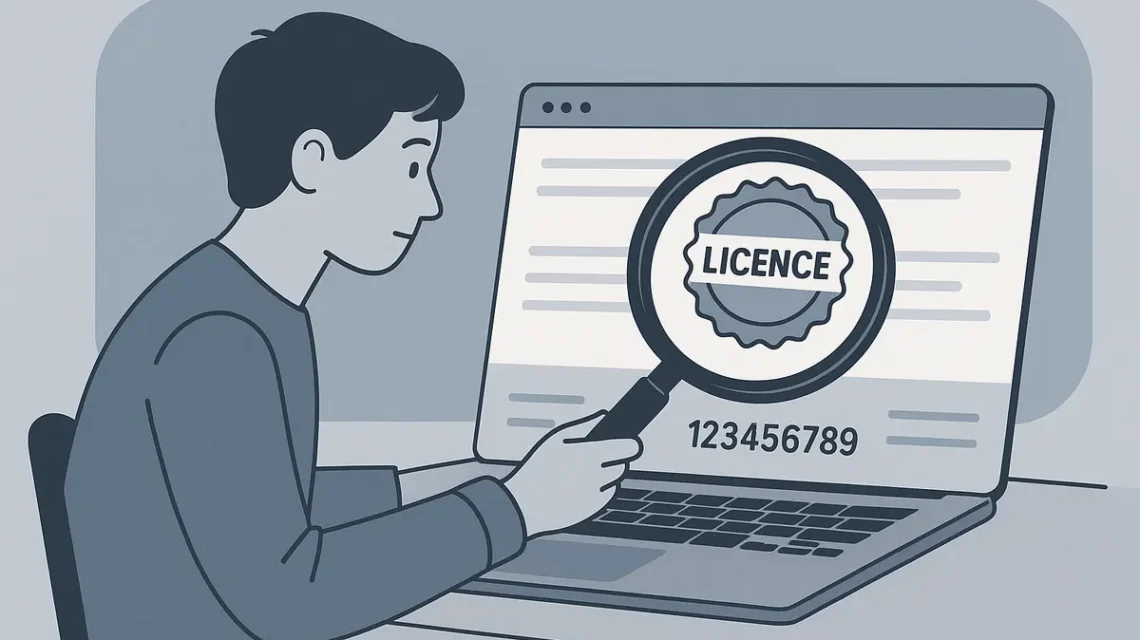
A licence logo in a footer is an image file. Anyone can upload one. Here is how to test it properly:
- Click the seal. A real one links through to the regulator’s site and returns a page confirming that specific operator. If it is not clickable, or it links back to the casino’s own page, treat it as decoration.
- Search the regulator’s public register using the licence number and the company’s legal name. The Malta Gaming Authority and the UK Gambling Commission both publish searchable licensee lists.
- Match the names exactly. A common trick is to display the licence of a related company, a former licensee, or a group entity that has nothing to do with the site you are on.
- Check the status and scope. The entry should say the licence is active, not suspended, lapsed or surrendered, and it should cover the products offered — casino, live dealer, betting.
- Look for the test lab. Games should be certified by an independent testing house such as GLI, eCOGRA, iTech Labs or BMM Testlabs. Certification covers RNG integrity and published RTP.
If any step fails, stop. There is no benign explanation for a licence number that does not appear in the register that supposedly issued it.
Recognised licensing authorities
Not all regulators demand the same things. Broadly, the licences that carry the most weight for players come from jurisdictions with detailed player-protection rules and a track record of fining or removing operators: the Malta Gaming Authority, the UK Gambling Commission, Gibraltar, the Isle of Man, Sweden’s Spelinspektionen, Denmark’s Spillemyndigheden and Ontario’s AGCO, among others.
Curaçao licences appear on a very large share of sites that accept Indian players. The framework there has been reformed, with the Curaçao Gaming Authority now issuing licences directly instead of the old master and sub-licence arrangement, but historically it was criticised as light-touch, and older sub-licence claims are still floating around. If a site cites Curaçao, verify it against the authority’s current register rather than assuming.
One more thing that trips people up: an MGA or UKGC licence protects players in the markets that licence covers. It is a signal of an operator’s general standards, not a promise that a regulator will take up your case from outside its jurisdiction.
Licensed vs unlicensed casinos: what’s the difference?
The gap is less about the games and more about what happens when something goes wrong.
| Area | Regulated operator | Unregulated operator |
|---|---|---|
| Game fairness | RNG and RTP tested and certified by an approved lab; results auditable | No independent testing required; published RTP unverifiable |
| Player funds | Typically must be segregated from operating funds, with protection levels disclosed | Balances may sit in general company accounts and vanish with the company |
| Complaints | Defined internal procedure plus access to an independent ADR body or the regulator | Support email is the final court of appeal |
| Identity checks | Mandatory KYC and anti-money-laundering rules, applied before payout | Checks often appear only at withdrawal, as a reason to delay it |
| Responsible gambling | Deposit, loss and session limits, reality checks, cool-off and self-exclusion | Optional at best; self-exclusion may not be honoured |
| Bonus terms | Must be clear and not misleading; wagering requirements disclosed up front | Terms can be changed, reinterpreted or applied retrospectively |
| Advertising | Content rules, age-gating and audience restrictions | Aggressive promotion, including to people already showing harm |
Player protections you get with regulated sites
Regulation does not improve your odds. The house edge is built into the maths of every game and does not care who issued the licence — a 96% RTP slot carries a 4% house edge over the long run either way. What regulation changes is whether the stated numbers are true and whether you can get your money out.
- Fund security. Licensed operators generally have to hold player balances separately from working capital and state what would happen to your money in an insolvency.
- Verified fairness. Certified RNGs and lab-tested return figures mean the advertised RTP and volatility reflect how the game actually behaves, rather than being marketing copy.
- Enforceable terms. Wagering requirements, max bet caps while a bonus is active and max cashout limits all still exist on regulated sites. The difference is that they must be disclosed clearly and cannot be quietly rewritten after you win.
- Real complaint routes. If the operator refuses a payout, you escalate to an independent dispute body or the regulator, which can fine or strip the licence.
- Working responsible gambling tools. Deposit and loss limits, time-outs, reality checks and self-exclusion that actually blocks the account.
Read our casino review methodology for how we weigh licensing against payments, game fairness and support when assessing safe casino sites.
Red flags of unregulated gambling sites
Most unlicensed operators give themselves away quickly, if you know what you are reading.
- No operator name in the footer. No legal entity, no registration number, no address. The single fastest tell.
- A licence seal that goes nowhere, or a licence number that returns nothing in the regulator’s register.
- A mismatched entity. The licence names a company that is not the one in the terms and conditions.
- Bonuses that make no commercial sense. A 500% match with no stated wagering requirement is not generosity; the catch is simply undisclosed.
- Vague payment terms. No withdrawal timeframes, unexplained “processing fees”, minimum cashouts far above the minimum deposit, or payouts only to crypto wallets.
- KYC weaponised. Registration takes thirty seconds, then verification demands appear only once you request a withdrawal.
- Support that isn’t. No live chat, an unanswered email address, or agents who cannot name the licensing authority.
- Terms that let the operator do anything. Clauses permitting account closure, bonus cancellation or confiscation of winnings “at the company’s sole discretion”, with no appeal route.
- Pressure marketing. Countdown timers, unsolicited messages, deposit prompts after a losing session. The GCI report’s point about the enforcement gap starting before the bet lands here.
- Copied content. Broken English in the terms, game thumbnails that do not load, or a support page still carrying another brand’s name.
Quick answers
How do I verify a casino licence in under two minutes?
Take the licence number and company name from the site footer, open the issuing regulator’s own public register, and search for it. If the entry exists, is active, names the same company and covers casino games, the licence is real. If it does not appear, the licence is not.
What makes online gambling regulated?
A specific authority licenses the operator, sets binding rules on fund segregation, RNG testing, KYC, advertising, bonus transparency and responsible gambling tools, audits compliance, and has the power to fine or remove the licence.
Why does gambling regulation matter if the odds are the same?
Because the odds are only meaningful if the game is genuinely random and the payout actually arrives. Regulation is what makes the published RTP verifiable and gives you somewhere to go when an operator refuses to pay.
The 72% figure is uncomfortable because it shows that unlicensed operators are not hiding in a dark corner of the internet. They advertise, they sponsor, and they look identical to the licensed alternatives until you check the footer. Checking it costs you two minutes.
And whatever you find in the register, gambling remains a form of paid entertainment with a negative expected return over time. Set a deposit limit before you play, never chase losses, and treat any money you stake as spent. If it stops being fun, use the cool-off or self-exclusion tools and see our responsible gambling resources for help.